
What if your customer’s AI assistant could be trained to prefer your brand? That’s the simple but powerful idea behind AI prompt loyalty, a concept that could reshape how brands think about retention in the AI-driven era.
While most marketers are still focused on showing up in generative search results, there’s a bigger opportunity hiding in plain sight: the private memories inside personal AI assistants like ChatGPT, Grok, and Perplexity.
When customers “seed” those memories with prompts about your brand, the AI begins to remember, recall, and recommend you more often. Over time, that creates a feedback loop where assistants reinforce loyalty in ways no ad campaign ever could.
At Trularity, we believe AI prompt loyalty is a pivotal concept. And if you move early, you can own it before your competitors even realize what’s happening.
What is AI Prompt Loyalty?
AI prompt loyalty is a marketing strategy where brands encourage customers to feed brand-relevant prompts into their personal AI assistants.
Unlike SEO or the latest buzzwords for AI search visibility (GEO, AEO, and so on), this isn’t about influencing public models. It’s about shaping the personalized memory each user builds with their own AI account.
Here’s how it works:
- A loyal customer asks their AI a natural question that touches on a brand strength, like “How do [Brand’s] ingredients compare to other skincare lines?”
- The assistant responds and stores that interaction as part of its memory.
- Over time, as the customer continues asking questions in this space, the AI starts associating the brand with those attributes.
- Later, when they ask a broader question like “What’s the best skincare option for sensitive skin?” the assistant is more likely to bring up that brand.
The goal isn’t to plant slogans but to encourage curiosity that reflects a customer’s genuine interests. Done well, these prompts shape how an AI remembers the brand, turning one-off interactions into lasting associations
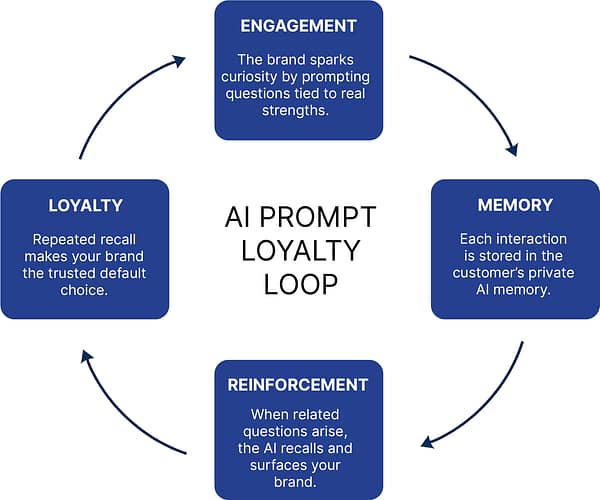
The AI Prompt Loyalty Loop
We call this cycle the Prompt Loyalty Loop, and it strengthens with every interaction.
- Engagement: The brand sparks curiosity by inviting a customer to ask their AI a question tied to a real brand strength. It might be about ingredients, speed, price, or service—something the customer already cares about.
- Memory: The AI doesn’t just answer once and forget. Modern assistants keep context, recall details, and adapt. Each prompt gets stored in the customer’s private memory bank.
- Reinforcement: Later, when the customer asks a related question (like “What’s the best option for…”), the AI recalls earlier context. Since your brand is already connected to that topic, it comes up more often.
- Loyalty: Over time, this loop compounds. The more the AI recalls your brand, the more the customer sees you as the default choice, reinforcing preference and trust.
Think of it like grooves forming in a record: every time a customer seeds a prompt, the needle goes a little deeper. Eventually, the AI is “trained” to treat your brand as the familiar, reliable answer. And because this lives inside the customer’s personal AI, competitors can’t easily disrupt it.
That’s what makes the Prompt Loyalty Loop so powerful. Each interaction compounds, creating a self-reinforcing cycle of recall and recommendation. Once established, it’s far more durable than traditional visibility tactics, because it lives inside the customer’s trusted assistant.
Why AI Prompt Loyalty Matters
AI prompt loyalty isn’t just another marketing buzzword. It matters because it intersects with three major shifts reshaping how customers make decisions today.
1. AI assistants are sticky.
Generative AI isn’t a novelty anymore. People are using it everyday. A poll by the AP-NORC Center for Public Affairs Research found that nearly 40% of U.S. adults aged 18-64 reported using generative AI, with about a third using it at least sometimes. These aren’t just casual interactions. People are starting to treat assistants like trusted advisors, asking them where to shop, what to buy, and which brands are best. It mirrors what happened in the early 2000s when Google quietly became the default gateway to the internet. The difference now is that AI assistants don’t just list links. They personalize answers. Once they’ve “learned” a preference, it tends to stick.
2. Personalization is expected.
The personalization train has left the station. McKinsey reports that 71% of consumers expect personalized experiences, and 76% get frustrated when they don’t get them. AI assistants are the ultimate personalization engines, built to adapt to each user’s habits and history. That means they’re not neutral territory. If a brand is part of the conversation, the assistant strengthens the connection. If it isn’t, customers quickly build habits and associations around competitors instead.
3. Brand visibility is fragile.
In traditional search, visibility was about ranking on page one. In generative answers, visibility means being one of a handful of recommendations. Inside personal AI assistants, visibility shrinks even further. It is about being recalled at all. If your brand isn’t in that private memory, you’re invisible. Worse, competitors who get there first create defensible moats that are difficult to dislodge. PwC projects that AI assistants will influence up to 40% of shopping decisions by the late 2020s. That means the stakes for being remembered, or forgotten, have never been higher.
The takeaway: AI prompt loyalty isn’t just a clever tactic. It could be the next battleground for customer retention. And the brands that start experimenting now will be the ones their customers’ AIs recall and recommend in the years ahead.

How AI Prompt Loyalty Works
So how does AI Prompt Loyalty actually play out in the real world? It unfolds in four steps that build on each other.
Step 1: Initiate Engagement
The process begins when a brand sparks curiosity. Instead of relying on ads, you invite customers to explore your strengths through their AI. For example:
- “Curious about our eco-friendly practices? Ask ChatGPT why [Brand] leads in sustainability.”
- “Wondering how fast we ship? Try asking Grok about [Brand’s] delivery speed.”
This isn’t manipulation. It’s simply offering a conversation starter in a channel that customers already trust. Prompt ideas give customers a reason to direct some of that activity toward your brand.
Step 2: Memory Formation
When a customer asks the question, the AI does not just answer once and move on. Modern assistants like ChatGPT and Grok use memory features to retain context across sessions. That means the interaction becomes part of the customer’s private AI history. Each repeated or related prompt strengthens the association. Think of it like telling a friend about your favorite brand multiple times. Instead of forgetting, the AI remembers and builds on the details.
Step 3: Reinforcement in Queries
Later, when the customer asks a broader question such as “What’s the best sustainable coffee brand?” their AI recalls earlier context. Since your brand is already linked to sustainability in that customer’s memory, it’s more likely to surface you as part of the answer. These reinforced associations can directly shape purchase decisions.
Step 4: Sustained Loyalty
The final step is the loop effect. Each time the AI recalls your brand, the customer sees confirmation of what they already believe: that your brand is relevant, reliable, or superior in some way. This strengthens trust and makes them more likely to ask again, which in turn adds new entries to the AI’s memory. Over time, the cycle compounds. What started as a single prompt becomes a self-reinforcing loop of recall and recommendation that competitors will find difficult to dislodge.
Ethical Framing
Let’s be clear: AI prompt loyalty isn’t about tricking customers or trying to game AI systems. It’s about giving customers the ability to shape their own AI experience in ways that genuinely reflect their interests and preferences.
Customers already expect personalization. McKinsey reports that 71% of consumers want tailored experiences, and 76% get frustrated when they don’t get them. The difference with AI prompt loyalty is that personalization doesn’t come from behind the curtain. Instead, it’s out in the open, guided by prompts customers choose to explore.
To keep this practice trustworthy and effective, brands should follow a few best practices:
- Consent and transparency: Present prompt ideas as optional and curiosity-driven. They should feel like an invitation, not an instruction.
- Authenticity: Only encourage prompts that highlight real brand strengths. If your shipping really is faster or your ingredients really are more sustainable, the AI’s answers will reinforce truth rather than hype.
- Diversity: Offer a variety of prompts so customers can explore different aspects of your brand. This prevents narrow or repetitive associations and helps the AI build a richer memory.
- Respect: Never pressure or coerce. The goal is to empower customers to explore your brand through their AI, not to control the interaction.
Done right, AI prompt loyalty feels like a natural extension of customer advocacy. In the past, brands said “Tell your friends about us.” Now the call is just as simple: “Tell your AI about us.” The difference is that friends might forget, but AI assistants remember.
Why This Could Be Category-Defining
AI prompt loyalty has the potential to be the next inbound marketing or growth hacking. It gives marketers a name and framework for a behavior they haven’t had words for until now.
Think about how marketing has evolved:
- SEO defined the Google era. Once brands realized search engines were how people discovered information, optimizing for rankings became a discipline of its own. Entire industries were built around it.
- GEO (Generative Engine Optimization) is defining the AI search era. As generative engines like ChatGPT and Perplexity started answering questions instead of listing links, brands rushed to figure out how to influence those outputs. GEO became the shorthand that gave structure to that movement.
- AI Prompt Loyalty could define the AI assistant era. This is the next shift, where decisions are shaped not only on the open web but also inside the private memories of personal AI accounts. It is not about page rank anymore. It is about recall rank, the measure of whether your brand is remembered when the assistant is asked.
Category-defining ideas don’t just describe change. They give marketers a lens to see the future and a framework to act on it. AI Prompt Loyalty does exactly that. It names the opportunity, it describes the mechanics, and it sets the stage for the playbook brands will need to compete in the years ahead.
If you’re a marketer, this isn’t just a curiosity. It’s a wake-up call. The brands that treat AI Prompt Loyalty as a real discipline today could be the ones customers’ assistants keep recommending tomorrow.
Getting Started with AI Prompt Loyalty
The best part? AI Prompt Loyalty is low-barrier to test. You don’t need new tech stacks or a huge budget. You just need creativity, authenticity, and a willingness to experiment. Here’s how to begin:
1. Identify brand strengths
Start by asking: What do I want a customer’s AI to remember about us? Maybe it’s your sustainability practices, your speed of delivery, your award-winning customer service, or the durability of your products. Pick two or three differentiators that customers already value. The more real and defensible they are, the better the AI will reinforce them over time.
2. Create prompt ideas
Translate those strengths into curiosity-driven questions. Instead of saying “We’re the best”, frame it so the customer asks the assistant to explore. Examples:
- “What makes [Brand] different when it comes to sustainability?”
- “How does [Brand’s] customer service compare to other options?”
- “Why do runners trust [Brand] shoes for durability?”
These are natural questions that customers might want to know anyway. You’re simply giving them the language to start.
3. Deliver through campaigns
Weave prompt ideas into the touchpoints you already use. An email newsletter could include a “Try this with your AI” box. A loyalty program might reward customers for sharing their favorite prompt ideas. A social post could invite fans to test a question and screenshot what their assistant says. The goal isn’t volume, it’s planting seeds with your most engaged customers.
4. Track engagement
Since you can’t see directly into a customer’s AI memory, you’ll need creative ways to measure. Surveys, polls, or community posts can reveal whether people are trying the prompts. You can also listen on social channels to see what customers share back. Even anecdotal feedback is valuable at this early stage.
5. Iterate
Like any marketing discipline, AI Prompt Loyalty will improve with testing. Refine the types of prompts you suggest, double down on the ones that customers enjoy asking, and keep experimenting with new ways to connect brand strengths to natural curiosity. Over time, you’ll learn what actually “sticks” inside assistants and what fades.
Think of it as brand storytelling, but told through the customer’s relationship with their AI instead of just public channels. Every prompt is a line in that story, and together they form a narrative that reinforces your place in the customer’s digital life.
Redefining Loyalty in the AI Era
AI assistants are quickly evolving from tools that answer questions to companions that help people shop, make decisions, and manage daily life. In that world, visibility won’t just mean showing up in search results. It will mean being part of the AI’s default memory for each customer.
AI Prompt Loyalty is how brands can prepare for that shift today. It isn’t expensive, it isn’t invasive, and it creates a self-reinforcing loop of trust that traditional ads can’t match.
At its core, the idea is simple: if AI assistants are becoming the gatekeepers of customer decisions, then brands need a way to live inside those assistants’ memories. But memory alone isn’t enough. What truly matters is how accurately the AI recalls you. That’s where AI Brand Fidelity comes in.
The future of loyalty might not be about points or perks. It might be about prompts. And the brands that understand that shift early will be the ones their customers’ AIs remember most.
What is AI prompt loyalty?
AI prompt loyalty is a strategy where brands encourage customers to ask brand-relevant questions in their personal AI assistants. Over time, those prompts help the AI remember and recommend the brand more often.
How is AI prompt loyalty different from SEO or GEO?
SEO and GEO focus on influencing public-facing algorithms and search results. AI prompt loyalty is private. It happens inside each customer’s personal AI account, shaping how their assistant recalls your brand
Is AI prompt loyalty just another form of advertising?
Not at all. Advertising pushes messages out. AI prompt loyalty is opt-in and curiosity-driven, letting customers explore brand strengths through questions they choose to ask.
Can small brands use AI prompt loyalty, or is it only for big companies?
This approach actually levels the playing field. Because it relies on engaged customers rather than ad spend, small and mid-sized brands can seed loyalty loops just as effectively as large competitors.
How do brands know if AI prompt loyalty is working?
You can’t see directly into a customer’s AI memory, but you can track engagement through surveys, community discussions, and social sharing. Anecdotal feedback is a strong early signal.
What are the risks of AI prompt loyalty?
The main risk is being inauthentic. If brands encourage prompts that don’t match real strengths, the AI may return weak answers. That’s why transparency and authenticity are essential.
Trularity studies how AI is reshaping the entire customer journey—from search and discovery to memory, preference, and long-term loyalty. Through original frameworks like AI Prompt Loyalty, we explore the emerging behaviors that will define the next era of AI-driven marketing. Our goal is to help brands understand the deeper mechanics behind how AI assistants learn, recall, and influence real customer decisions.