
Most marketers are watching the same scoreboard: AI rankings, generative answers, and whatever acronym replaces SEO next. That work matters. but it’s only half the picture. There’s a new metric no one’s talking about, and it may become more important than visibility itself.
We call it AI brand fidelity.
Brand fidelity is the strength and stability of the connection between a brand and the way AI systems remember, interpret, and talk about that brand over time. In other words, it measures how faithfully an AI reflects your brand’s true identity in its answers.
This is not about how often you show up. It’s about how accrately you show up. And accuracy is the foundation of trust in an AI-driven world.
AI brand fidelity is the next frontier in marketing and the brands that understand it early will have a major advantage.

What Is AI Brand Fidelity?
AI brand fidelity is the consistency between a brand’s real identity and the version of that brand an AI assistant carries in its learned memory. It focuses on three questions:
- Does the AI correctly understand what your brand stands for?
- Does it recall your strengths when it matters?
- Does it present your brand in a way that matches your voice and values?
Today, AI assistants don’t just answer questions. They maintain context. They develop internal mental models of brands. They remember interaction patterns over time. And they fill in gaps with their own interpretations if you do not provide clarity.
If the model misunderstands your brand, that misunderstanding can influence every future recommendation, comparison, and summary. Once that mental model is in place, it is very difficult to correct.
AI brand fidelity is the measure of how well your brand survives that process.
Quick example: If your brand is known for durability but the AI keeps describing you as “budget-friendly,” your fidelity is low even if your visibility is high.
This diagram shows how your brand’s real identity is transformed as it moves through the AI assistant’s internal model and is delivered back to the customer. AI brand fidelity is the measure of how closely that final output matches the truth of your brand.

Why Brand Fidelity Matters
1. People trust AI summaries more than ads or websites
Most users increasingly rely on AI assistants to explain things quickly. They want a clean overview. They want a simple comparison. They want a recommendation they can trust. If the summary is wrong, your brand is at risk. If the summary is too generic, your differentiation disappears.
High fidelity means the AI speaks your truth. Low fidelity means the AI speaks for you.
2. AI assistants compress brand stories into shortcuts
AI does not store every detail. It stores themes. It looks for patterns. If your messaging is inconsistent, unclear, or scattered, the AI fills in the gaps with whatever pattern looks most likely. That can lead to misalignment.
High fidelity means your themes survive compression. Low fidelity means your meaning is lost.
3. Low fidelity creates invisible competitive losses
If an AI mistakenly links your brand to the wrong attributes, it can reduce your relevance in entire categories. You may never know why you lost recommendations. The AI simply recalls another brand with a clearer identity.
High fidelity protects your category space. Low fidelity gives up territory without a fight.
4. Brand fidelity becomes recall rank
In the world of AI, the most powerful position is not page rank. It is recall rank. That is the order in which the AI thinks about possible answers before generating its response. High fidelity improves your chances of being recalled first. Recall is the new ranking.
Example: Ask an AI, “What is the best project management tool for freelancers?” It immediately recalls a handful of brands before it writes anything. That invisible shortlist determines the winner.
The Three Layers of AI Brand Fidelity
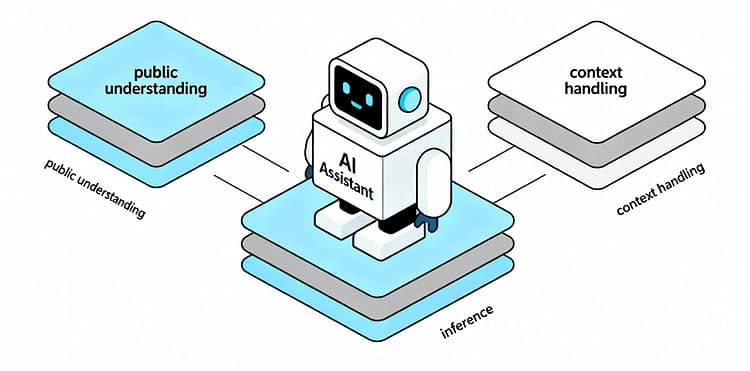
Brand fidelity is built in layers. Each layer influences how the AI classifies you, recalls you, and recommends you.
- Layer One: Public Understanding
This is the part of your brand that AIs learn from public data, articles, reviews, and your own website. It needs to be clear, consistent, and easy for a model to understand at a glance. If you confuse the model here, everything built on top of it becomes shaky. - Layer Two: Context Handling
This is the AI’s personal memory of conversations involving your brand. It includes customer questions, comparisons, and anything that reinforces your strengths. High fidelity depends on the clarity of these interactions. - Layer Three: Inference
This is where AI fills in the blanks. It guesses what traits match your brand based on patterns. If your message is inconsistent, the AI guesses wrong. If your identity is strong, the AI reinforces it. Inference is where fidelity is won or lost.
What Causes Low AI Brand Fidelity
Low fidelity often occurs when:
- Messaging is inconsistent or competing
- The website uses vague or abstract language
- The brand’s category positioning is unclear
- There is not enough third-party clarity
- Reviews point toward the wrong interpretation
- The AI sees mixed signals across channels
Many brands create what we call fidelity drift. This is the slow shift between the brand’s true identity and the identity the AI remembers. Once drift begins, visibility tactics struggle because the AI is not recalling the correct version of the brand.
How to Improve AI Brand Fidelity
You can’t control the entire AI ecosystem, but you can influence how faithfully an AI understands you.
Here are the levers:
- Clarify your core brand idea in simple language
AI prefers clarity. The cleaner your core brand statement, the stronger your embedding. Use plain, direct language. Avoid jargon. Be unmistakable. - Strengthen your category narrative
AI needs to know what you do and also who you compete with. Clear category positioning improves recall and reduces ambiguity. - Make your website AI friendly
Use short sentences, clear headings, and key facts in the first 150 words. This is where the AI decides what matters. - Encourage customers to ask brand-relevant questions
This ties into the idea of AI prompt loyalty. The more customers ask about your strengths, benefits, and differentiators, the stronger your brand’s internal model becomes. - Use third-party clarity signals
Interviews, reviews, FAQs, social posts, and educational content help reinforce your brand definition from multiple angles. - Audit your AI summaries regularly
Ask multiple AI models to explain your brand. If something sounds wrong, fix your source content. Brand fidelity audits will soon become standard practice.
What High Brand Fidelity Looks Like
When a brand has high fidelity:
- The AI describes it the same way the company does
- The brand’s strengths survive compression
- Recommendations are consistent
- Comparisons reflect real differentiation
- Customer assistants recall the brand accurately
- The brand maintains its position over time
High fidelity gives the brand a stable place in the AI’s mental map. That stability becomes a competitive advantage.
Why This Idea Matters Now
AI is becoming the new interface for customer decisions. People ask assistants what to buy, who to trust, and which brand fits their needs. The assistant answers from its internal model. That model is only as good as the information it learned.
SEO taught brands to optimize for search engines. GEO teaches brands to optimize for AI answer engines. AI brand fidelity teaches brands to optimize the internal memory of AI systems.
This is a deeper layer of marketing. It focuses on identity rather than exposure. It helps protect the truth of your brand in a world where AI compresses, summarizes, and interprets everything.
Once you see the importance of brand fidelity, you cannot go back.
Final Thought
AI brand fidelity is the hidden metric that will shape the next decade of marketing. It influences how AIs understand you, summarize you, and recommend you. It protects your identity inside the systems customers rely on every day.
Visibility gets you noticed. Fidelity gets you trusted.
As AI becomes the gatekeeper of decisions, the brands that survive will be the ones whose identities remain intact inside the model. AI brand fidelity is not a trend. It’s the new foundation of brand strategy.
What is AI Brand Fidelity?
AI Brand Fidelity is the accuracy and consistency of the version of your brand stored inside an AI system’s internal model. It reflects how closely an AI’s understanding matches your real identity, values, strengths, and positioning.
Why does AI Brand Fidelity matter?
AI assistants increasingly act as the first touchpoint for discovery, comparison, and recommendations. If the AI misunderstands your brand, every summary, suggestion, or answer can become misaligned, causing lost opportunities and reduced trust.
How is AI Brand Fidelity different from visibility or SEO?
SEO and AI visibility determine whether your brand shows up. Brand fidelity determines how you show up. Visibility may get you included, but fidelity ensures the AI describes your brand correctly when it matters.
What causes low AI Brand Fidelity?
Low fidelity is often caused by inconsistent messaging, unclear category positioning, vague website language, or mixed signals from reviews, social content, and customer interactions. These inconsistencies make it harder for AI to form an accurate model.
How do AI systems “remember” a brand?
AI systems learn from public information, user interactions, patterns across the web, and contextual signals inside each conversation. They compress this information into internal representations or “mental models” that influence future answers.
Can AI Brand Fidelity be improved?
Yes. Clear messaging, strong category positioning, consistent language across all channels, and third-party clarity signals all contribute to a more accurate internal model. Regularly auditing AI summaries is also essential.
What does high AI Brand Fidelity look like?
A brand with high fidelity is consistently described the way the brand intends. The AI recalls the correct strengths, differentiators, and category. Recommendations are accurate, summaries are consistent, and the brand’s identity remains stable over time.
Is AI Brand Fidelity measurable?
While there isn’t a universal metric yet, brands can assess fidelity by testing how multiple AI assistants describe their identity, competitors, strengths, and category. Clear patterns often reveal where fidelity is strong or drifting.
Does brand size affect fidelity?
Not necessarily. Large brands have more data, but smaller brands with clear messaging can achieve stronger fidelity than big brands with fragmented signals. Consistency, not size, determines recall accuracy.
How often should brands check their fidelity?
As AI models evolve quickly, quarterly audits are recommended. Major rebrands, website changes, or shifts in messaging should trigger additional checks to ensure the AI’s internal model stays aligned.
How does AI Brand Fidelity relate to AI Prompt Loyalty?
Brand fidelity focuses on how the AI interprets your identity. Prompt loyalty focuses on how customers train that identity by consistently asking AI assistants about your strengths. Together, they shape the AI’s long-term memory and recall behavior.
Trularity uncovers how AI systems form internal models of brands and how those models shape real customer decisions. Through original concepts like AI Brand Fidelity and AI Prompt Loyalty, we help marketers understand the unseen mechanics that determine how accurately AI assistants remember, represent, and recommend their brand. Our mission is to give companies the clarity they need to thrive in an AI-driven marketplace.
Feature image courtesy of Vecteezy.com.